
Explainer
Who's driving? The SAE levels of self-driving, explained simply
You hear it all the time: "This car is Level 2." "That robotaxi is Level 4." But what do these levels mean?
They come from SAE International, a group of engineers that writes standards for cars. Their standard, called J3016, sorts driving automation into levels. People often talk about "the five levels of self-driving." There are really six, because the scale starts at Level 0, where there is no automation at all.
The easy way to understand the levels is to ask one question: what does the human still have to do?
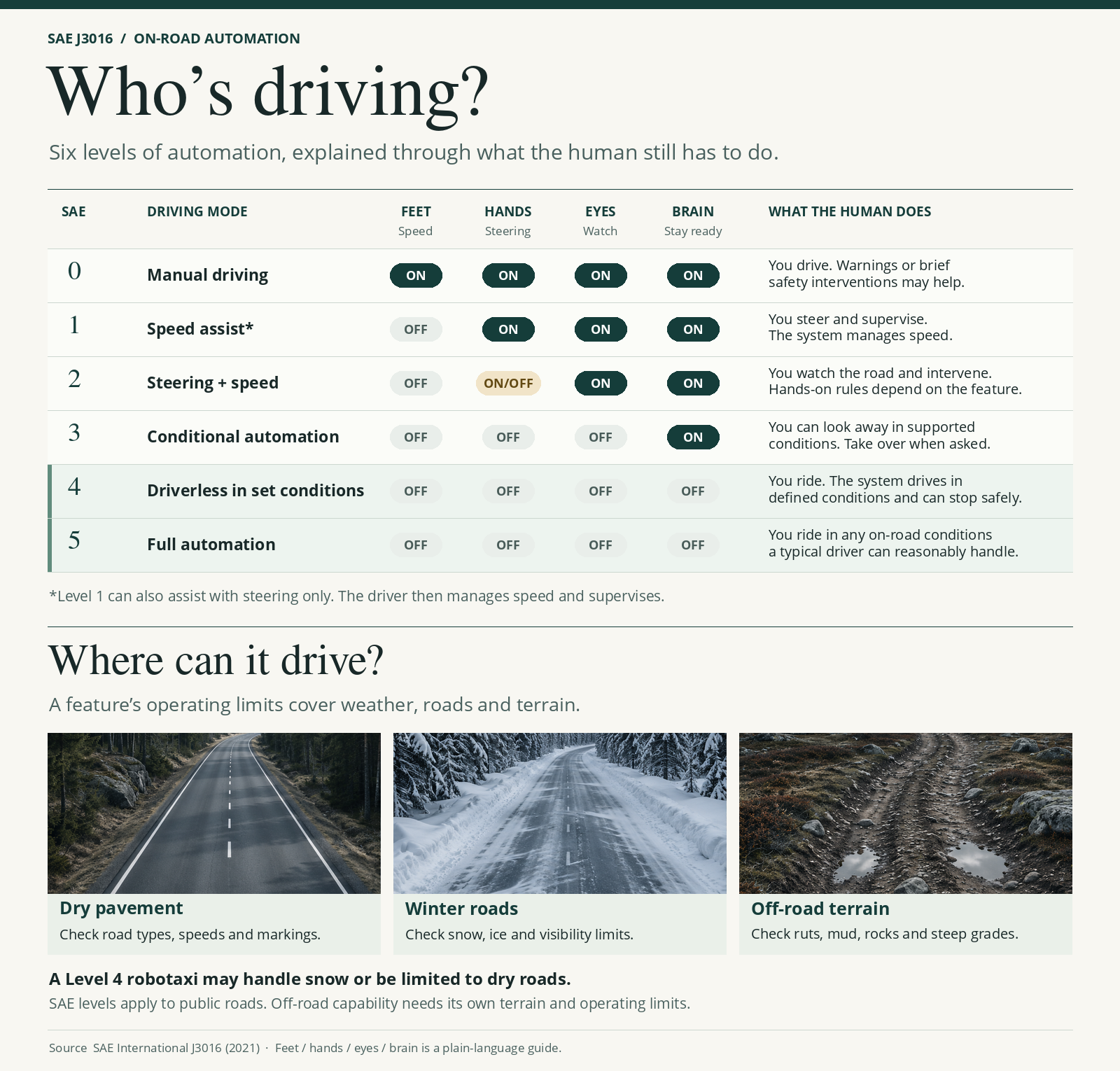
Feet, hands, eyes, brain
Think of driving as four jobs:
- Feet control the speed.
- Hands steer.
- Eyes watch the road.
- Brain stays ready to take over.
As the level goes up, the car takes over more of these jobs.
Level 0: Manual driving
You do all the driving. The car may beep to warn you or brake hard in an emergency, but you are in charge the whole time.
Level 1: Driver assistance
The car helps with one thing, usually speed. Adaptive cruise control is a good example. It keeps a safe distance from the car ahead. You still steer and pay full attention.
Level 2: Steering and speed
The car can steer and control speed at the same time. Some systems let you take your hands off the wheel on certain roads. But your eyes must stay on the road, and you must be ready to take over at any moment. Most "self-driving" features sold in cars today are Level 2. The driver is still the driver.
Level 3: Conditional automation
This is the big step. In certain conditions, such as slow highway traffic, the car does all the driving and you can look away. But you must stay ready. When the car asks you to take over, you have to do it.
Level 4: Driverless in set conditions
There is no driver. You are a passenger. The car drives itself, but only in the places and conditions it was built for, such as one city or good weather. If something goes wrong, it can pull over and stop safely on its own. Robotaxis are Level 4.
Level 5: Full automation
The car can drive anywhere a typical human driver could, in any conditions. No Level 5 car exists today.
Why this matters in winter
A level tells you who is driving. It does not tell you where the car can drive.
Every self-driving feature has limits, called its operating conditions. These cover the type of road, the speed, and the weather. A Level 4 robotaxi might be built to handle snow and ice, or it might only work on dry pavement. Both are still Level 4.
That is why, at Winter Autonomy, we always ask a second question: can it drive here, in a Canadian winter? Snow covers lane markings, ice builds up on sensors, and roads get slippery. A car that works well in sunny weather has not proven anything until it works in the snow.
So the next time you hear that a car is "Level 4," ask two things: who is driving, and in what conditions?
Source: SAE International J3016 (2021). "Feet, hands, eyes, brain" is a plain-language guide, not part of the standard.